PARK CITY, Utah -- Two Ivy League track athletes turned bobsledders and a cross country runner who now competes in the biathlon were among the 110 Olympic hopefuls invited to participate in the 2017 Team USA Media Summit in Park City, Utah, from Sept. 24-27.
The multitalented athletes were emblematic of the theme of the summit—talent transfer, a key initiative as the United States works to gain a stronger foothold in sports not readily accessible or enthusiastically followed at home. The three Ivies, like many of their peers, each were talented enough to be recruited to play NCAA Division I sports but have since parlayed those skills into an entirely different sport for Team USA.
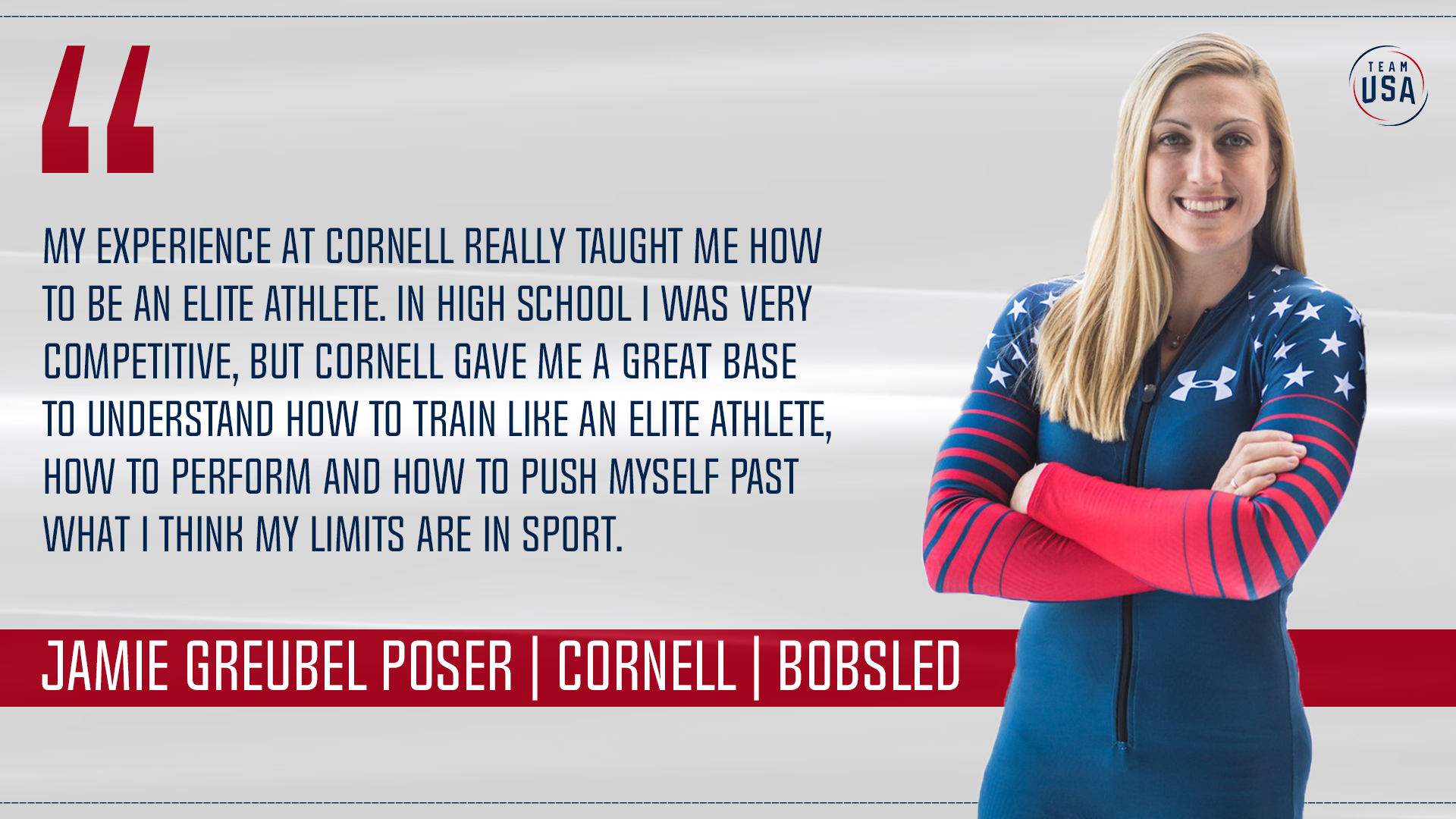 Jamie Greubel Poser
, a 2006 graduate of Cornell, was a four-time Ivy League champion—three times in the heptathlon (2003, 2005, 2006) and once in the pentathlon (2006)—and still holds the program record in both events. She helped lead the Big Red to eight-straight Ivy League track & field team titles, four indoor and four outdoor, during her career in a Cornell uniform. She also competed for a year on the Big Red field hockey team, appearing in three games as a freshman. Her four years in Ithaca, N.Y., were integral to her development into an elite athlete worthy of talent transfer.
“My experience at Cornell really taught me how to be an elite athlete,” said Greubel Poser. “In high school I was very competitive, but Cornell gave me a great base to understand how to train like an elite athlete, how to perform and how to push myself past what I think my limits are in sport.”
Armed with that base understanding, Greubel Poser went on to make the U.S. National bobsled team in 2007 and her first Olympic team in 2014. She was a bronze medalist in the two-woman bobsleigh with teammate
Aja Evans in Sochi.
Despite already owning an Olympic medal, qualifying for the 2018 Winter Olympic Games in PyeongChang, South Korea, has even greater significance for Greubel Poser, whose 17-year-old younger sister Elizabeth was adopted from South Korea.
“The second that [PyeongChang] was named, I just knew that it was meant to be for me and I had to do everything I could to get there,” said Greubel Poser. “I never thought that I would have that type of connection in my sports career because everything before that was self-motivated and driven. I have always been so competitive and that’s why I’ve wanted to compete and be the best in the sport, but this has a whole other meaning.”
“If I make the Olympic team in 2018, I’ll be able to bring my family and it will be my sister’s first time going back to South Korea since we adopted her when she was five months old.”
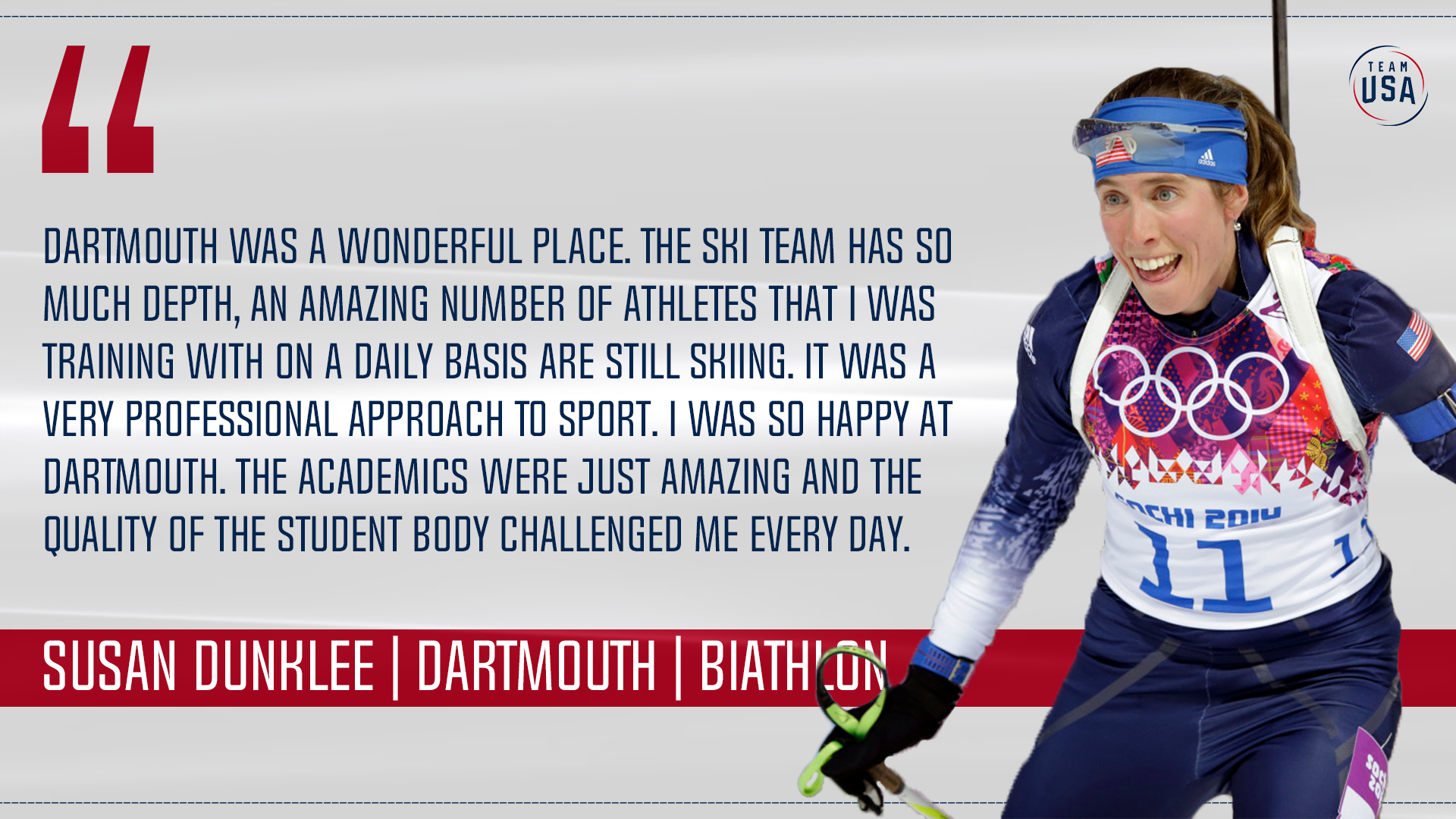 Susan Dunklee
, a 2008 graduate of Dartmouth, was a two-time Second Team All-Ivy cross country runner (2004, 2006), while also competing in cross country skiing for the Big Green. She was part of Dartmouth’s last NCAA championship team, helping the Big Green to the 2007 NCAA Men’s and Women’s Skiing Championships crown, and was a two-time All-American (2007, 2008) in the sport.
Dunklee made her first Olympic team in 2014, placing 12th in the mass start in Sochi, and has already punched her ticket to PyeongChang. Her father,
Stan Dunklee, was also a two-time Olympian, competing in cross country skiing at the 1976 and 1980 Winter Olympics. Her uncle,
Everett Dunklee, competed in the event in the 1972 Games.
In recent years, Dartmouth has become a training ground for the U.S. Cross Country Ski Team and the U.S. Biathlon Team—with four of Dunklee’s fellow Big Green alumni also representing the United States at the 2014 Winter Olympics in Sochi.
Sara Studebaker (2007) and
Hannah Dreissigacker (2009) joined Dunklee in competing in the biathlon, while
Ida Sargent (2011) and
Sophie Caldwell (2012) competed in cross country skiing.
“Dartmouth was a wonderful place. The ski team has so much depth, an amazing number of athletes that I was training with on a daily basis are still skiing,” said Dunklee. “It was a very professional approach to sport. I was so happy at Dartmouth. The academics were just amazing and the quality of the student body challenged me every day.”
That constant challenge of her peers at Dartmouth—and on the Big Green ski team—helped prepare Dunklee for an even greater challenge when transferring to the biathlon. She began cross country skiing at age five, but did not learn to shoot until she joined the U.S. Biathlon development program in 2008 at age 22.
A self-described late bloomer, Dunklee is now the United States’ best shot at an Olympic medal in the biathlon, the lone Winter Olympic event in which the country has never medaled. In February, she became the first American woman to win an individual medal at an Olympics or World Championships in biathlon, capturing the silver medal in the mass start at the 2017 Biathlon World Championships in Hochfilsen, Austria.
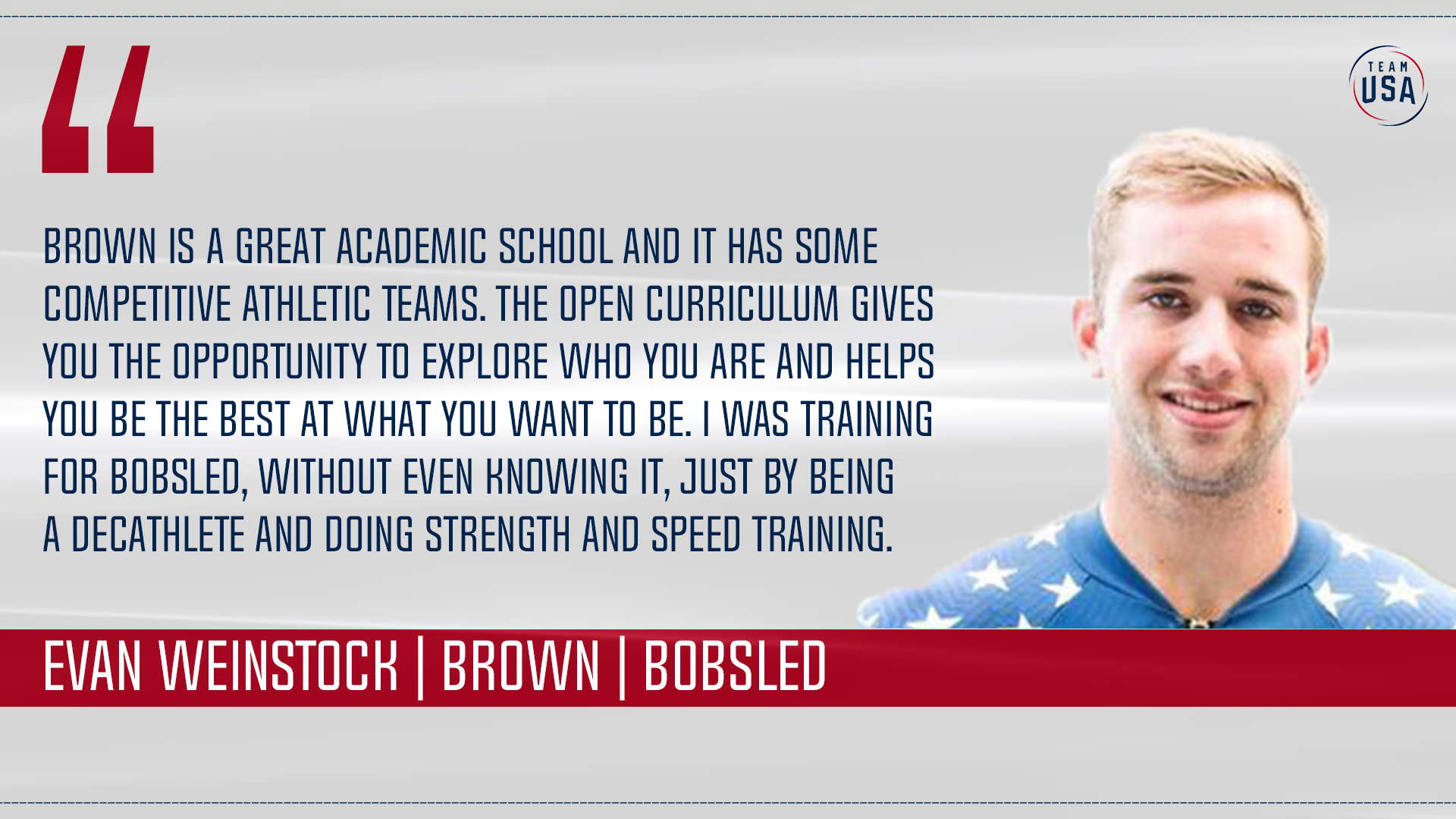 Evan Weinstock
, a 2014 graduate of Brown, was a four-time Ivy League champion—three times in the decathlon (2011, 2013, 2014) and once in the heptathlon (2013). He still holds the Brown program record, and two of the top three Ivy League championship meet totals, in the decathlon. Weinstock was also recruited to play football by the Bears, after being named the Nevada 4A High School Football Player of the Year, but chose to focus his training on track & field in Providence, R.I.
His experience at Brown, and specifically training for the decathlon, prepared him for his future pursuit of a spot on the U.S. Olympic Team in bobsled.
“Brown is a great academic school and it has some competitive athletic teams. The open curriculum gives you the opportunity to explore who you are and helps you be the best at what you want to be. I was training for bobsled, without even knowing it, just by being a decathlete and doing strength and speed training,” said Weinstock.
Weinstock initially represented Team USA in the decathlon, but transitioned to bobsled in 2015. He has been part of pilot
Justin Olsen’s sled since 2016. Olsen competed in both the 2010 and 2014 Olympics and was a gold medalist in the four-man bobsleigh in 2010 in Vancouver.
Like Weinstock and Greubel Poser, many United States bobsledders are products of the talent transfer initiative, which makes recruiting NCAA athletes essential to the success of the USA Bobsled and Skeleton Federation.
“The NCAA system is widely important for bobsled,” said Weinstock. “Bobsled, because it’s such an obscure sport, you don’t really have people growing up saying they want to be a bobsledder. You need to be really active in recruiting the NCAA athletes once they graduate. I think bobsled is a great opportunity for NCAA athletes to continue on with their athletic career.”